
In the Lower Primary years, Nairobi Waldorf School Trust offers a connected and engaging educational experience. Our curriculum is woven with art, storytelling and experiential learning, aimed at igniting young students’ curiosity and imagination. This period is instrumental in shaping their approach to education, embedding a deep-seated appreciation for creative thinking and a holistic view of the world.
Block Rotation
Our block rotation model allows students to focus deeply on a single subject for several weeks, ensuring they grasp core concepts thoroughly. Subjects include math, language arts, science, and humanities, all interwoven with creative and physical activities.
The Lower Primary Program is characterised by: Experiential and hands-on learning methods to engage and captivate, an integrated curriculum that brings together literacy, numeracy, science, and language arts in a cohesive and relatable manner, a strong emphasis on artistic expression, including regular sessions featuring painting, music, craft and movement, introduction to our string instrument music program in Class 4, including first solo and orchestral performances and our focus on reading program to enhance literacy and cultivate a love for reading.
The Class Teacher assumes a central role in guiding the children through a journey of discovery and learning, and the same teacher will stay with the class for multiple years. A rich curriculum delivered through story, art, music, nature science and practical activity awakens and develops the power of imagination in students. During these years, a love of learning is fostered and a solid academic foundation built through experiences infused with meaning and feeling.
Grade 1 – Laying the Foundation for Lifelong Learning
The Class 1 curriculum at Nairobi Waldorf School Trust is designed to ignite curiosity and instill a love for learning. By integrating academics with creativity and practical activities, we nurture the intellectual, artistic, and physical development of each child. This year is dedicated to cultivating positive classroom habits that will support their educational journey ahead. The students, along with their teacher, lay the groundwork for a strong and evolving relationship, while fostering a sense of community and collaboration within the class during this important year of new beginnings.
Main Lesson: A Dynamic Start to the Day
The Main Lesson is the cornerstone of the Class 1 curriculum, offering an immersive two-hour session each morning. Key topics are introduced through engaging storytelling, imaginative exploration, and hands-on activities. Highlights include:
- Language Arts: Introduction to consonants (B, D, F, G, etc.) through storytelling and dynamic movement, fostering early literacy and creative expression.
- Mathematics: Exploration of numbers and their archetypes (e.g., “one” represents unity), counting up to 100, and working with Roman and Arabic numerals to build numerical literacy.
- Form Drawing: Developing motor coordination and spatial awareness by drawing straight and curved lines, which lay the groundwork for writing skills.
Specialty Subjects
Class 1 students engage in a variety of subjects that inspire creativity and broaden their skills:
- Music: Singing, recorder playing, and percussion help children develop rhythm, breath control, and vocal production. Songs often align with seasonal themes, culminating in performances during festivals.
- Handwork: Activities such as knitting enhance fine motor skills, patience, and eye-hand coordination while fostering creativity and a sense of accomplishment.
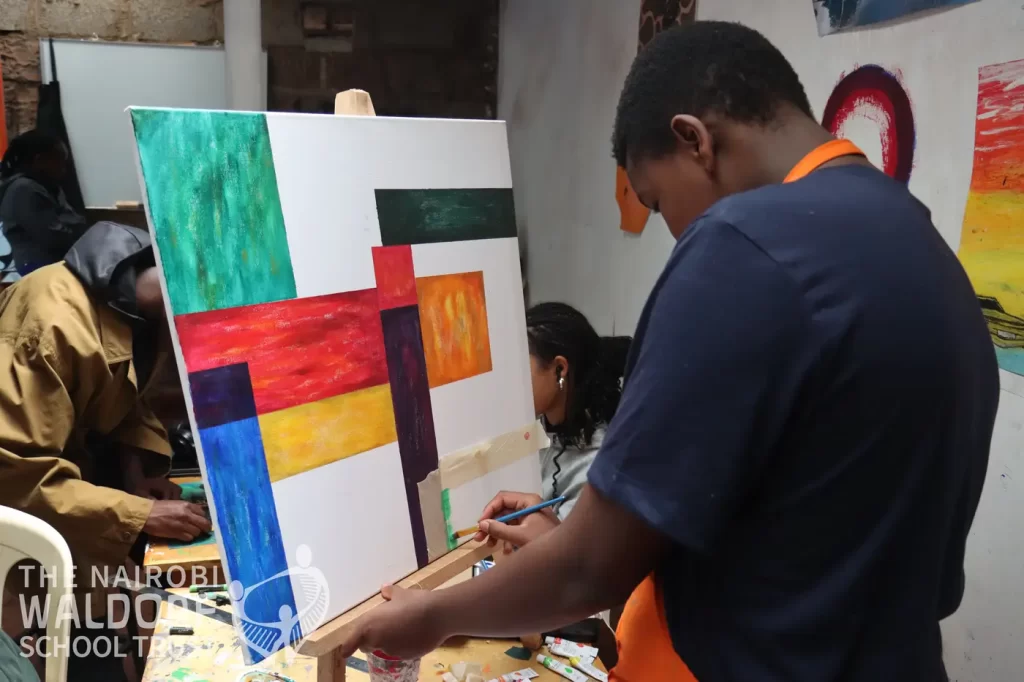
- Painting: Exploring color and form nurtures artistic expression and emotional balance.
- Swimming: Progressive lessons focus on mastering flutter kicks, backstroke, and water confidence, blending physical coordination with water safety skills.
- Games and Movement: Activities like hula hoops, dodgeball, and jump rope build gross motor coordination, spatial awareness, and teamwork.
Kiswahili: Building Language Foundations
Kiswahili lessons incorporate songs, storytelling, and playful interaction to introduce children to greetings, body parts, family members, and numbers. These rhythmic and engaging sessions develop pronunciation, vocabulary, and confidence in using the language.
Grade 2 – A Year of Growth, Discovery, and Duality
Grade 2 is an exciting time for our students as they transition from the tender qualities of first grade to a more confident and coordinated stage of development. Physically stronger and full of energy, children at this age enjoy boundless curiosity about the world around them. Their growing sense of independence and ability to balance dualities—such as kindness and mischief—forms the foundation of their intellectual and emotional growth this year.
Thematic Curriculum Highlights
Stories that Inspire and Teach
Second graders delve into the duality of human nature through fables and legends. Animal tales help children identify with their instincts, while stories of saints and holy figures inspire them to strive for the best in themselves. These stories enrich class discussions, performances, and creative writing projects, creating a balanced and meaningful educational journey.
Language Arts
- Speaking and Listening: Students build confidence through expressive recitations, speech exercises, and creative storytelling. They enjoy group and solo performances, acting out fables, and working on clarity and articulation with fun activities like tongue twisters.
- Writing and Reading: With a transition to lowercase letters, students begin composing short stories, letters, and nature descriptions. Reading skills are strengthened through phonics, decoding words, and collaborative class reading projects. These activities foster a love for language and self-expression.
Mathematics
Students develop agility with numbers and expand their knowledge of addition, subtraction, and multiplication. Through rhythm, movement, and artistic representations, math becomes a dynamic and engaging subject. This year also introduces practical problem-solving exercises and the foundational concepts of place value and carrying.
Specialized Subject Lessons
Form Drawing
Form drawing introduces symmetry and balance, helping students develop spatial awareness and fine motor skills. Mirrored drawings and symmetrical designs challenge their imagination while nurturing a sense of harmony.
Handwork
Knitting, stitching, and crafting projects such as dolls and small bags teach dexterity and patience. By working with natural materials, students learn practical skills while cultivating a connection to ecology, creativity, and resourcefulness.
Painting
In watercolor painting, students explore the inner qualities of colors and practice creating balanced compositions. Activities focus on primary, secondary, and complementary colors, allowing students to develop a sense of color harmony and emotional expression.
Music, Kiswahili, French, and Swimming
Our robust subject rotation includes music, where students engage in singing, rhythm, and recorder practice; Kiswahili and French to foster language development; swimming to build confidence and coordination; and various games to enhance teamwork and physical fitness.
Enriching Classroom Experiences
Social Development Through Play and Games
The lively energy of Grade 2 children is channeled into games that build social-emotional skills, cooperation, and healthy competition. The playground is a vibrant space where friendships deepen, and physical development thrives.
A Daily Rhythm
Grade 2 students attend school from 8:00 a.m. to 3.15 p.m., following a structured yet flexible rhythm that supports learning, creativity, and play.
Grade 3
In Grade 3, students experience a significant shift as they begin to build a stronger sense of independence. Noticeable physiological, psychological and cognitive changes take place in the child this year. The nine/ten year threshold represents a very significant step in self-awareness. Children realize they are separate from their surroundings and meet the world as individuals, often resulting in increased questions, self-doubt and wonder. Waldorf gives its third-grade lessons a practical orientation. This stage focuses on developing responsibility, self-confidence, and understanding their place within the community. The curriculum at NWST blends academic rigor with creativity and practical life skills.
Core Subjects and Activities:
- Mathematics: Students explore multiplication, division, and measurement. The practical approach helps them see how math applies to everyday life, from constructing buildings to understanding the world around them.
- Language Arts: Emphasis is placed on reading comprehension, spelling, and grammar, as students enhance their writing skills. The development of clear communication is a priority, with storytelling and journaling as key tools.
- Handwork: Practical skills like knitting, crocheting, and sewing are taught, fostering patience and fine motor skills.
- Physical Education: Through movement, students engage in exercises that improve coordination, balance, and strength, while encouraging teamwork and perseverance.
- Movement: This expressive movement form is integrated into daily activities, helping students enhance both their physical and emotional awareness.
- Geography and History: Students begin learning about the world’s various cultures, focusing on the relationship between people and the land they live on.
- Science: Observational and experiential learning form the core of the science curriculum, including topics such as plant growth, simple machines, and animal studies.
- Music: Class 3 students refine their musical skills by singing in rounds and maintaining independent melodies. They practice this both vocally and on the recorder. Basic music theory is introduced through storytelling, leading to sight-playing and simple melody composition. Rhythmic work is reinforced through singing, playing, and practical exercises, strengthening their overall musical foundation.
A Typical Day in Grade 3:
The day at NWST is thoughtfully structured, offering balance and flow between academic lessons, creative time, and outdoor activities. Students begin their day with morning circle time, followed by focused learning sessions in core subjects. Afternoons are dedicated to artistic and practical activities such as handwork, gardening, and physical education, allowing children to explore their interests and abilities.
Shelter and House-Building – Exploring Human History and Practical Skills
As part of our study of geography and history, Grade 3 students at NWST dive into the fascinating journey of how humans began to build shelters. Starting with the Biblical concept of “man’s first home,” we explore how early humans, after being expelled from Paradise, created ways to protect themselves from the elements. Students learn about how the environment shaped the types of homes built across different regions—whether on stilts, made of grass, mud, or other materials.
Hands-On Learning: Building Models and Presentations
Students will get to design and construct models of different types of houses based on their studies. This project encourages creativity and practical thinking, as students present their designs to the class and answer questions about their choices, materials, and building process.
A Real-Life Project
In addition to the model building, the class may take on a small building project on the school grounds, applying what they have learned about structures and construction. This hands-on experience gives students a deeper understanding of architecture and teamwork. At NWST, our Grade 3 students actively engage in hands-on building projects as part of their practical learning experience. At the Karen Campus, they constructed the gazebo, while at the Lavington Campus, they built the store. In 2025, they will take on a new challenge, helping refurbish the exit gate at the Karen Campus. These projects foster teamwork, problem-solving, and a deep sense of accomplishment, reinforcing the Waldorf philosophy of learning through doing.
Grade 4
By Grade Four, students embrace greater independence and curiosity, building on solid academic foundations to explore engaging projects and an inspiring curriculum. This stage celebrates their individuality as they delve into personal interests, talents, and challenges within a diverse and supportive class community. With confidence and enthusiasm, Class Four students are ready to take on new challenges, deepening their understanding of themselves and their place in the world.
Music
The Grade Four music curriculum nurtures students’ growing musical abilities through singing, recorder playing, and an introduction to the violin. Students refine their recorder techniques, focusing on tone, posture, and accurate fingering, while also learning to sing with controlled breath and strong vocal production. They are introduced to the violin, where they practice proper handling, bowing techniques, and playing simple tunes. Sight-reading, rhythmic clapping, and playing in rounds enhance their musicality and teamwork. The term concludes with preparations for the Festival of Light, where students showcase their progress and creativity in a collaborative performance.
Games
The games curriculum for Grade Four focuses on developing physical fitness, teamwork, and foundational skills across various sports. Students participate in athletics, football, cricket, and basketball, with each activity designed to enhance coordination, endurance, and confidence.
Athletics introduces leg and arm coordination, running techniques, and aerobic endurance, helping students improve their speed, balance, and body control. In football, learners focus on ball control, dribbling, passing accuracy, and body movement, honing their ability to handle the ball with their feet, chest, and head. Cricket lessons emphasize key skills such as batting, bowling, throwing, catching, and fielding, ensuring students develop accuracy and confidence in each aspect of the game.
Basketball brings in dribbling, passing, rebounding, shooting, and defensive techniques, allowing students to build strategic thinking and teamwork on the court. Throughout the term, the curriculum encourages active participation, skill mastery, and the joy of playing games, fostering motivation and self-confidence in every student.
Mathematics focuses on strengthening numerical understanding, problem-solving skills, and confidence in mathematical operations. Students work with whole numbers, fractions, place value, and learn to identify prime numbers. Mental arithmetic, long division, and multiplication are emphasized, and students practice applying mathematical concepts through real-world word problems.
Kiswahili progresses to a more advanced level, with students developing both oral and written skills. They practice reading, writing, and constructing sentences while learning grammar concepts such as noun classes, verb conjugation, and plural forms. The aim is to foster fluency in speaking and writing Kiswahili while understanding key language structures.
English in Grade 4 focuses on grammar and creative expression. Students learn to use nouns and their determiners, explore verbs in different tenses, and deepen their understanding of adverbs. Emphasis is placed on developing both technical language skills and creativity in storytelling, writing, and conversation.
French builds on previous learning with a focus on individualized learning. Students engage in dialogues, write short sentences, and practice reading and spelling through poems and stories. Key topics include telling time, identifying masculine and feminine words, and developing a basic understanding of French grammar.
Handwork lessons encourage students to develop practical skills and inner strength. Students begin with cross-stitch and running stitch, creating small projects such as table mats. They progress to more complex creations like decorative pouches and pillows, helping them apply their growing skills to functional and decorative items.
Swimming in Grade 4 focuses on refining swimming techniques and building endurance. Students work on mastering strokes like freestyle, backstroke, breaststroke, and butterfly, focusing on body positioning, coordination, and stamina. They are encouraged to build confidence in their swimming ability through both technique and physical conditioning.
This comprehensive curriculum is designed to nurture well-rounded development in Grade-Four students, promoting academic growth, physical fitness, creativity, and language skills.
Grade 5
Fifth-grade students are developing confidence in academics, art, and movement. They are also becoming more socially adept and building character as they meet the demands of approaching adolescence. It is an age of rapidly flowering powers. The pictorial element is still strong in the children’s thought process. Still, they are also developing the capacity for comprehending matter-of-fact, sense-free concepts and dawning a sense of conscience and personal responsibility. Physically, the children are coordinated, with increased stamina and an ability to bring beauty to their movement, which is given expression in their fifth year through participation in the Olympic games.
This year the aim is to make the transition from myth to history and its emphasis on the individual. The children should develop a greater consciousness of the interrelatedness of life and environment — particularly in the study of botany and geography. There will be an emphasis on the original Olympian ideal in which group distinctions are subservient to the greater whole and in which qualities such as beauty are as valued as speed and distance. The children should be encouraged to strengthen their memory by learning such things as vocabulary and by visualising spaces through the use of maps.
Grade 5 Curriculum
In Grade 5, students embark on an exciting journey of growth and exploration, deepening their understanding of the world around them. The curriculum integrates hands-on learning with academic subjects, emphasizing critical thinking, creativity, and the development of strong social skills.
Core Subjects:
- Mathematics: Grade 5 students master more advanced arithmetic, including fractions, decimals, and geometry, through practical and artistic methods.
- Literature & Language Arts: Reading, writing, and oral presentations flourish as students study classic tales, myths, and legends from various cultures, enhancing their communication skills.
- Science: Focused on the natural world, students explore topics like botany, geology, and physics, often through experiments and nature walks.
- History: Students journey through the ancient civilizations, exploring the cultures and achievements of early societies, fostering a strong understanding of human history.
- Geography: The study of geography includes map-making and the exploration of physical features and cultures around the globe, encouraging a broader worldview.
Creative & Physical Development:
- Arts: Students participate in drawing, painting, and modeling, using art to connect with and internalize the academic subjects they study.
- Movement: Physical education emphasizes teamwork, coordination, and rhythm, helping children build confidence and a sense of physical well-being.
- Music: Students continue to develop their musical abilities through instrument study, choral singing, and rhythm exercises.
Through these diverse subjects, Grade 5 students at NWST cultivate their intellectual curiosity, enhance their personal growth, and develop a balanced sense of self. This stage in their education nurtures their social skills and prepares them for the more complex challenges ahead.
Upper Primary (Grade 6 -8)
The Upper Primary Program builds on the strong foundation laid in earlier years, guiding students through a transformative phase of growth and self-discovery. At this stage, children develop greater independence in thinking, a deepening sense of curiosity, and an emerging ability to analyze the world around them. The curriculum is designed to meet these changes, offering more structured academic challenges while maintaining the creative and experiential approach that defines Waldorf education.
Learning remains immersive and interdisciplinary, with history, science, mathematics, and language arts explored in ways that connect to real-life experiences. Artistic expression continues to be a core element, with music, drama, and visual arts woven into daily lessons. In these years, students begin to develop critical thinking skills, confidence in communication, and a growing sense of responsibility—both for their learning and their role within the community. The Class Teacher continues to provide stability and guidance, fostering an environment where students feel supported as they navigate the transition into adolescence.
Grade 6
Children begin a new phase of development between their tenth and twelfth years. By the age of 12, their harmonious physical proportions typical of the middle period of childhood have usually been lost. The limbs begin to predominate and the muscular system becomes increasingly important. Psychologically, there is a critical attitude and the children’s newly won capacity to think must now be taken into account. The intellectuality now preparing to claim its right to be heard must be pointed in the appropriate direction by the teacher and other adults. The students’ questioning and searching attitude should be directed increasingly toward nature and its laws. They want to find out about laws that exist independently of humanity and remain valid despite this. It is important, however, that a strong personal and subjective element is retained, with the children knowing that those who are doing the searching and discovering are still human beings and not some incomprehensible instruments.
Core Subjects
English
Students refine their reading, writing, and speaking skills through literature, creative writing, and grammar. Classic tales, myths, and historical narratives inspire students to explore themes of morality, courage, and human ingenuity. They engage in poetry analysis, essay writing, and dramatic presentations, building both confidence and expression.
French
The French curriculum immerses students in the language through conversational practice, vocabulary building, and cultural exploration. Students learn foundational grammar, engage in simple dialogues, and enjoy songs and stories that introduce them to French culture.
Swahili
Swahili lessons focus on enhancing language fluency, incorporating storytelling, grammar exercises, and vocabulary expansion. Emphasis is placed on cultural context, enabling students to connect with the rich heritage of East Africa.
Exploring the Sciences
Geology
Class 6 students delve into the fascinating world of geology, exploring the Earth’s layers, types of rocks, and the processes that shape our planet. Hands-on activities, such as rock identification and model-making, encourage practical understanding.
Zoology
The animal kingdom comes alive as students study mammals, their characteristics, habitats, and adaptations. Lessons highlight the interconnectedness of life, fostering appreciation and respect for the natural world.
Creative and Practical Arts
Handwork
Students create intricate projects like embroidery or knitting that challenge their fine motor skills and creativity. These activities also teach patience, perseverance, and attention to detail.
Black and White Drawing
Through black-and-white drawing, students explore form, contrast, and shading techniques. These artistic skills are integrated into other subjects, such as illustrating scientific observations or historical events.
Music
Music education includes singing, learning instruments, and understanding musical notation. Students may participate in ensemble performances, developing harmony and teamwork.
Physical Development
Games and Swimming
Physical education fosters teamwork, coordination, and physical fitness. Games encourage strategic thinking and sportsmanship, while swimming lessons build confidence and endurance in the water.
Understanding the Past and Present
History
History lessons take students on a journey through ancient civilizations, focusing on the Roman Empire and its impact on modern society. Students explore themes of governance, innovation, and societal change, enriching their understanding of human history.
Grade 7
In Seventh Grade, curiosity is blossoming. The students’ intense physical and mental growth propels them toward new experiences. They’re yearning for independence, but still need guidance and structure.
The class seven teacher exhibits consistency, certainty, controlled humour, self-reflection, and above all understanding, in order to be able to deal with this stage of development successfully. Parallel to this, the students are presented with a great deal of challenges in the form of tasks and projects, which they enjoy. In their endless quest for knowledge, they are encouraged to extend sympathy towards others and matters of the world at large. One of the ways to achieve this is through growing interest in great people that ever lived, (biographies). They need to be reassured that their allied leader is also reliable and worthy of emulation.
Mathematics
Class 7 mathematics focuses on refining analytical and problem-solving skills. Topics such as algebra, geometry, and advanced arithmetic are introduced, helping students strengthen their logical reasoning and numerical fluency. Hands-on activities and real-world applications make math both accessible and engaging.
English Language
The English curriculum emphasizes creative and analytical writing, grammar, and literature study. Students delve into poetry, short stories, and novels, exploring themes that inspire discussion and critical thinking. Public speaking and debate are introduced to build confidence in self-expression.
French
French lessons in Class 7 expand vocabulary and conversational skills. Students learn to express themselves fluently in everyday contexts and deepen their understanding of French culture and traditions through interactive activities and storytelling.
Kiswahili
In Kiswahili, students focus on enhancing their reading, writing, and speaking skills. Lessons are designed to celebrate the richness of East African heritage while developing proficiency in the language. Emphasis is placed on storytelling, grammar, and composition writing.
Music
Music education nurtures creativity and teamwork. Class 7 students explore ensemble performances, instrumental practice, and musical theory. Collaborative projects like composing and performing songs foster a love for music and strengthen their sense of rhythm and harmony.
Handwork
Handwork lessons encourage dexterity and patience through projects such as advanced knitting, embroidery, or crafting functional items. This subject helps students develop an appreciation for craftsmanship and tangible creativity.
Perspective Drawing
Students are introduced to the principles of perspective drawing, exploring depth, proportion, and spatial awareness. This discipline enhances their observation skills and artistic abilities, connecting technical precision with imaginative expression.
Games and Sports
Games and sports are integral to physical development and teamwork. Students participate in group sports and individual activities that build endurance, coordination, and discipline. Emphasis is placed on fair play and fostering a sense of community.
Swimming
Swimming lessons focus on developing confidence and technique in the water. Students learn advanced strokes, water safety, and endurance training, helping them build strength and resilience.
Class 8
The child is now faced with the task of permeating with consciousness the spheres of life, rhythm, and formative forces. The Waldorf curriculum supports this task through a study of the forces that form the earth from within (earthquakes, volcanoes, and the movement of the tectonic plates) and from without (wind, waves, and weather). Underlying historical dynamics can be revealed through a study of the Age of Revolutions, which include not only the political and industrial revolutions, but also the electronic and information revolutions. Students learn about social and governmental forms of historical and contemporary nations, in contrast to their study of economic life in seventh grade.
A central theme for eighth grade is the study of life in general, which includes human anatomy and organic chemistry of starches, sugars and fats. Transformations of these processes, such as soap making and oil refining, can then be examined in industrial settings. The formative development of the human being, including the sense and inner organs, tissue layers and skeleton, should be treated dynamically here, with biorhythms as an especially interesting theme. Rhythmic techniques in the arts and crafts support the child’s developing consciousness of this sphere of life. Such techniques include veil painting and shaded drawing, rhythmic and dance forms in music and eurhythmy and the use of the plane or spokes in woodworking.
English Language
Through literature, creative writing, and speech, students in Class 8 develop their ability to express themselves with clarity and confidence. They engage with stories that mirror their own inner journeys, exploring themes of transformation, morality, and resilience. These lessons cultivate critical thinking and a deeper appreciation for the power of language.
French
French studies continue to blossom as students refine their grasp of grammar and expand their vocabulary. They explore French culture through songs, stories, and conversational practice, building confidence and fluency in expressing themselves in this rich and beautiful language.
Kiswahili
Kiswahili lessons connect students to the linguistic and cultural heritage of East Africa. By delving into poetry, storytelling, and written expression, they deepen their command of the language while discovering the wisdom and beauty embedded in Kiswahili traditions.
Music
Music remains a vital thread in the Class 8 curriculum, offering students the opportunity to connect with rhythm and harmony on a deeper level. They engage in ensemble work, composing, and performing, discovering how music can express the joys and challenges of life.
Fine Arts
Through painting, drawing, and sculpture, students explore artistic themes that resonate with their growing individuality and awareness of the world. These creative pursuits provide an outlet for self-expression and encourage a sense of beauty and balance.
Games and Sports
Physical activity is an essential part of the Class 8 experience. Whether through team sports or individual challenges, students strengthen their physical endurance and learn the value of cooperation, discipline, and perseverance.
Mathematics
Mathematics lessons unfold with complexity and purpose, introducing concepts like algebra and geometry in a way that relates to the real world. Students are encouraged to approach problem-solving with curiosity and determination, building confidence in their abilities.
Physics
In physics, students explore the fundamental forces that shape our world. Through hands-on experiments and observation, they develop a sense of wonder and inquiry, connecting abstract concepts to the phenomena of everyday life.
Geography
Geography invites students to journey across continents and cultures, studying the interconnection between human beings and the Earth. Themes such as climate, ecosystems, and global interdependence inspire a sense of responsibility and care for the natural world.
History
History lessons bring the past to life, helping students see how the stories of humanity have shaped our present. From the rise and fall of civilizations to pivotal historical moments, they develop a deep appreciation for the forces that have influenced human progress.